#Incometax #Budget
Union Budget 2021 has introduced provision that makes interest on employee contributions exceeding Rs.2.5 lakhs a year to the Employees’ Provident Fund as taxable w.e.f. April 2021. This also covers contribution by Government employees towards GPF.
However, the provision is going to impact only High net worth individuals since Interest above 2.5 lakhs can be earned P.A. only when you are having corpus of 28 lakhs+.
Exact Provision along with clarification will be rolled out soon.
Thursday, February 4, 2021
Taxation of Interest on PPF

Friday, October 2, 2020
Due date to file ITR for AY 2019-20
The due date to file ITR for AY 2019-20 under section 134(4) --Belated Return
and section 139(5) -- Revised return
has been extended to 30.11.2020 due to COVID.
Earlier it was 31.03.2020 which was extended to 30.09.2020 and now further extended to 30.11.2020
Do file your pending ITR for AY 2019-20 before time passes out.
Sunday, September 6, 2020
No section 194N TDS if cash withdrawn isn’t income of account holder: Madras HC
| Sharing case law posted by Taxmann. |
| Assessee was a society licensed by the RBI to carry on banking business. The main account holders of assessee-society were various Primary Co-operative societies which provide loans and advances. Assessee granted loan to the member societies. The member-Societies withdraw cash from their accounts for making cash disbursements of loans granted to farmers as most of the farmers did not have bank accounts. |
| Income-tax Officer (ITO) conducted survey proceedings at the business premises of assessee and found that assessee was not deducting TDS under section 194N. Based on data gathered during the survey, show cause notices were issued to assessee. He called assessee to explain why an order should not be passed under section 201(1) and 201(1A) to recover the default amount with interest from them. |
| Assessee contended that by reading section 194N along with section 201, one can safely conclude that if sum received by assessee will not be an income at his hands, question of deduction under section 194N will not arise. The Bombay HC in case of Rashmikant Shah v. Union of India [2019] 108 taxmann.com 181 (Bombay) has held that the provision of TDS is not a charging provision. It only makes deduction of tax at source on payment which is income in hands of payee. If the payee has no liability to pay tax on such income. Liability to deduct TDS in the hands of the payer cannot be fastened. |
| On writ, Madras HC held that AO failed to take into account the entire scheme of the Act and proceeded at breakneck speed. Thus, the matter was remitted back to AO for issuing fresh notice to assessee. Assessee was, at liberty, to bring on record the returns filed by member societies who had withdrawn cash beyond the ceiling limit of Rs. 1 crore. |
| It was open to assessee to establish before AO that the sums withdrawn by the member societies do not represent income at their hands. If AO was satisfied that the amount withdrawn did not represent income at their hands, he will drop further action. If he is not so satisfied, it was open to him to pass further orders in accordance with the law. |
Sunday, May 31, 2020
Deductions under Income Tax pertaining to period 01.04.2020 to 30.06.2020
The Central board for direct taxes has released updated ITR forms for Ay 2020-21.
As we all know financial year of 2019-2020 was extended from 31.03.2020 to 30.06.2020 due to COVID-19 pandemic, the CBDT has made respective changes in the ITR forms so that deduction/ investment/deposit/ payment for above 3 months can be claimed.
For this purpose, Schedule DI has been added to ITR forms where various sections of Chapter VIA are mentioned.
Any contribution/deduction to be claimed for above 3 months have to be separately disclosed under this schedule against respective section. (screen-shot attached below for reference)

Tuesday, May 26, 2020
MSME-1
ALL ABOUT MSMEs
(part-1)
MSME sector has always remained an area of key focus for the Indian Economy. Growth of this sector plays major role in overall growth of the economy. As per data, this sector contributes around 29.7% of GDP and around 49.66% of Indian exports.
Through this article following key points will be discussed:-
- What are MSMEs and recent change in definition of MSMEs?
- Registration of MSMEs and Relevance of Udyog Aadhaar
- Process of applying Udyog Aadhaar
1. What are MSMEs?
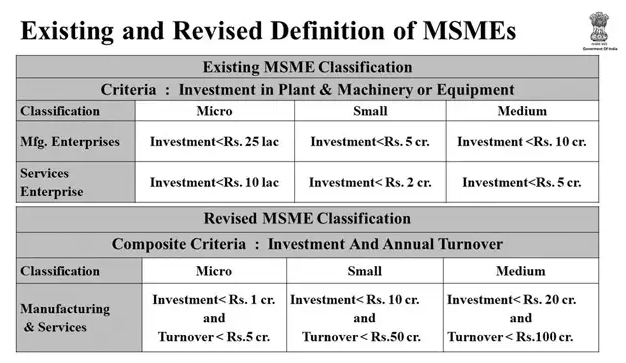
MSMEs are governed by Micro Small and Medium Enterprises act,2006. Before the announcement by Finance minister on 13.05.2020 as part of measures for AATMA NIRBHAR BHARAT, the MSMEs were usually divided into Manufacturing and service industries. As can be visible from below provided table, the limits for Investment were different in Manufacturing and service industries.
However, post the announcement of 13.05.2020, key observations are:-
- there is no distinction between manufacturing and service industry
- a new parameter of turnover has been added
- parameters of turnover and investment will be seen combined as the word AND is used instead of OR
- investment limit for each category has been increased manifold i.e. from 25/10 lacs to 1 cr in Micro, from 5/2cr to 10 cr in Small and from 10/5 cr to 20 cr in Medium enterprises
 |
2. Relevance of Udyog Aadhaar.
As discussed above there are criteria with respect to turnover and investment to be met for a business to be categorized as MSME.
But simply meeting the above criteria does not make your business covered under MSME. To enjoy the benefits available to MSME, one has to first register his business under Udyog Aadhaar.
It is nothing but like an Aadhaar card for your business. It comes with a registration certificate and a unique number in order to certify your business as MSME. Simply saying it is MSME certificate.
Under this the owner, director or proprietor of entity will have to provide his/her aadhaar number.
All types of entities can obtain Udyog Aadhaar including sole proprietorship, LLP, partnership firm, Companies under companies act, 2013 etc.
3. Process of applying Udyog Aadhaar
Following steps will provide an overview as to how to apply for Udyog Aadhaar and as a result be registered as MSME:-
- Visit the official website:- udyogaadhaar.gov.in
- Enter Aadhaar number as discussed above (if not available then Udyog Aadhaar memorandum can be filed)
- Enter Name of Entrepreneur (as per Aadhaar card)
- Enter OTP
- Enter Social category like General, OBC, SC, ST etc.
- Entity details to be entered( in case of more than 1 entity, details of all to be mentioned)
- Address of Entity to be filled
- Enter Incorporation date
- Enter bank details
- Classification of enterprise
- Other details like Turnover and Investment
Post submitting above details, documentary proofs for above details to be attached and then a Unique number along with MSME status is provided to the business.
(In our next article, we will be discussing various benefits and schemes, MSMEs are entitled to, and the special credit arrangements available to them)
Sunday, May 24, 2020
IncomeTaxUpdate
Section 269SU of Income tax act states that any person carrying on business and having sales or receipts more than 50 crores during immediately preceeding previous year will have to provide facility to accept payments through electronic modes like:-
1. Debit card
2. BHIM UPI
3. UPI QR code
Circular 12/2020 was released by dept. on 23.05.2020 to allow persons carring only B2B businesses not to comply the above provisions provided 95% of their receipts come from modes other than cash.
This circular came to resolve the issue that in B2B businesses size of payments is usually big and accepting such heavy amounts through above mentioned modes is not possible.
Such receipts are possible commonly through NEFT/RTGS only.
Subscribe to:
Posts (Atom)
-
This term has recently got attention as it was used by the Finance Minister during her recent speech at Punjab and Sind Bank. This term ori...
-
Introduction This section is introduced to cover high value property transactions under Tax net.This section intends to cover the Gross ...
-
ALL ABOUT MSMEs (part-1) MSME sector has always remained an area of key focus for the Indian Economy. Growth ...
